
Listen to the article
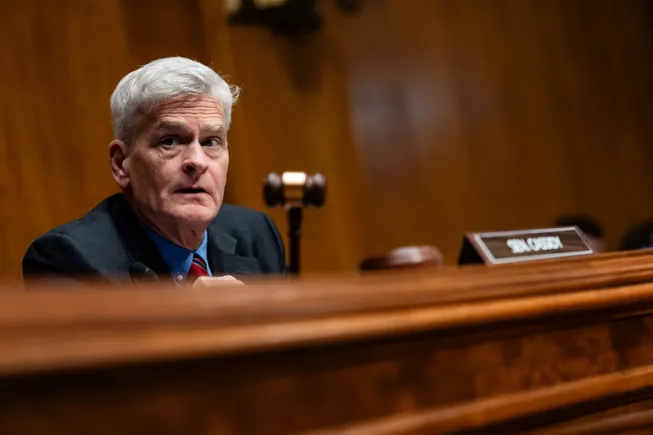
Senator Bill Cassidy, R-La., the outgoing chair of the Senate Health, Education, Labor and Pensions Committee, plans to soon release legislation reforming the No Surprises Act, according to a top aide.
Over the last few months, Cassidy has held a series of roundtables with insurers, providers and other stakeholders to identify issues with the law, which was passed in 2020 to protect patients from unexpected medical bills. The NSA has been successful in that regard. However, the law has been roundly criticized — by insurers, which argue that doctors are gaming the NSA’s payment resolution process to nab sky-high awards, assisted by groups meant to be independent arbiters; and by providers, which complain that insurers aren’t doling out payments.
Cassidy, one of the authors of the NSA, has been working on “comprehensive legislation” to restore the law’s key goals, including encouraging providers to go in-network with insurers and lowering healthcare costs broadly, Romney Gripado, a health policy advisor to Cassidy, said during a Thursday event hosted by the Georgetown University Center on Health Insurance Reforms in Washington, D.C.
“Our proposal, which will be released soon, focuses on strengthening program integrity, improving oversight of [arbiters], restoring accountability, increasing transparency around the entire dispute resolution process, and ensuring that the dispute resolution process is fair and predictable for those involved,” Gripado said. “We’re also focused on protecting employers from unnecessary costs, ensuring that providers are compensated in a timely fashion, and addressing the incentives that might be driving increased utilization of arbitration.”
For Cassidy, addressing shortcomings with the NSA is likely a project to preserve his legacy. The veteran health senator will leave Congress at the end of the year after losing his seat. However, NSA reform is an uphill battle — there are few areas of consensus over how to reform the law, despite growing calls that something needs to be done to curb its excesses.
For one, instead of nudging out-of-network providers to ink contracts with insurers, the NSA appears to actually be rewarding them for remaining out of network. Federal data shows that providers file and win the vast majority of IDR claims, and frequently take home awards well above comparable in-network rates. The law has even created a cottage industry of middlemen that help providers dispute claims and bring home massive payouts.
Meanwhile, arbiters — meant to serve as neutral referees between insurers and providers — are incentivized to allow ineligible claims into the system and rule in favor of providers, given they’re paid by dispute.
Snowballing disputes, award amounts and administrative costs have generated more than $22 billion in additional spending in just four years, according to Georgetown research. Insurers and employers say the NSA’s costs are a growing burden, and one they’ll have to pass along to consumers in the form of higher premiums.
And the situation is only expected to worsen, according to experts. The U.S. is on track to exceed 4 million NSA disputes in 2026, up from 2.5 million in 2025, said Jack Hoadley, a researcher with the Georgetown’s McCourt School of Public Policy, during the Thursday event.
For context, regulators initially expected about 17,000 disputes a year when they crafted the arbitration process.
“If you think about what that means for those dollar figures, obviously we don’t know yet. We don’t have data on the award levels and all the other stuff. But with a higher volume of cases, that $22 billion is going to go up quite a bit,” Hoadley said.
Cassidy’s legislation will join another bill introduced by Rep. Frank Pallone, D-N.J., another key architect of the law. Pallone’s legislation would throw out the arbitration process altogether and instead tie payment for out-of-network claims to in-network rates, a fix backed by insurers but loathed by physicians.
Other reforms on the table include setting a ceiling for awards, requiring arbiters to consider in-network rates more heavily in their deliberations, penalizing arbiters for allowing ineligible cases and forcing insurers to pay out awards more quickly.
Cassidy’s bill will take a middle-of-the-road approach, according to Gripado.
“While these stakeholders don’t always agree, and there’s millions of dollars on the line in disputes between them, we look forward to finding a pathway where we can have a common sense, bipartisan consensus,” she said.
Cassidy plans to put out legislation before he leaves Congress. But it’s unlikely anything will pass before the end of the year, as Democrats ready themselves to assume leadership of the House and Senate in 2027. Next year could see a fix, according to Jackson Hammond, a senior policy analyst at the Paragon Health Institute.
“Lame duck’s not happening,” Hammond said during the event. But “I have a lot of positive faith that 2027 is a good year for this. There’s bipartisan interest in doing something.”